Classifying Proxy Blocks: Distinguishing Rate Limits, Bans and Errors
Not every block is the same. How to classify proxy failures as rate limits, bans or plain errors, and why the fix is different for each.
A Block Is Not One Thing
When a request fails, saying “it is blocked” hides the real problem. A proxy block can be a rate limit, a ban on an IP range, a session break or simply a network error. Each has a different fix, and applying the wrong one wastes time. Classification is the first diagnostic step.
Treat the failure as a signal to read, not a verdict to accept.
Rate Limits Are a Warning
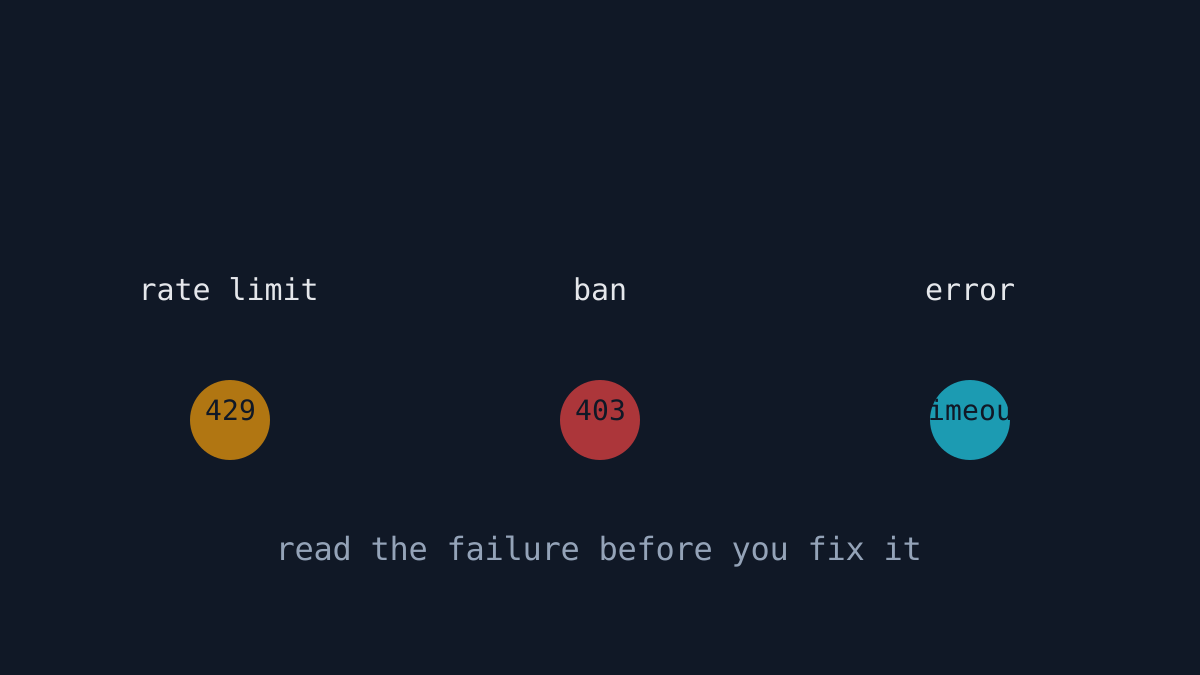
A 429 or a pattern of requests succeeding then suddenly failing is usually a rate limit, not a block. The target is throttling you, not banning you. The fix is to slow down, widen the gaps and rotate less aggressively. The rotation guide and the latency budgets guide cover how to shape traffic so limits do not escalate.
A rate limit respected often disappears. A rate limit ignored becomes a ban.
Bans Are an Identity Problem
A persistent failure on a specific IP or range, even at low volume, points to a ban on that identity. The fix is to move to a different IP or pool rather than retry the same one. The pool diversity guide explains why spreading across subnets and types reduces this exposure.
If a whole pool starts failing, the identity problem is at the pool level, and a different tier may be needed.
Errors Are Not Blocks
Timeouts, connection resets and malformed responses are often infrastructure problems, not target hostility. Check the gateway checklist and the health baseline before assuming you are blocked. A misconfigured timeout or a flaky route can look identical to a ban.
Measure the status code and the timing, and only then decide what you are dealing with. The docs cover the error signatures, and the proxies catalog shows the pool profiles that reduce each type of failure